Under Sink Organizer Manufacturer: Complete OEM Buying Guide?
You're searching for a reliable under sink organizer manufacturer. But here's what most buyers miss: the real quality isn't about how the product looks—it's about how it handles pipes, rust, weight, and daily pulling.
Finding the right OEM partner for under sink organizers means understanding five critical manufacturing factors: pipe clearance design, smooth sliding mechanisms, anti-rust coating, load-bearing capacity, and installation simplicity. A good manufacturer delivers all five without compromising cost or lead time.
I've been making kitchen hardware for 17 years now. And I can tell you this—most importers focus on price first. Then they get samples that look great. But three months after launch? Customer complaints flood in. The sliding rails jam. The coating peels. The organizer can't fit around their sink pipes.
Let me walk you through what actually matters when you're choosing an under sink organizer manufacturer. Not the marketing stuff. The real production details that separate a reliable factory from a problem waiting to happen.
What Makes Under Sink Organizers Different from Regular Storage Racks?
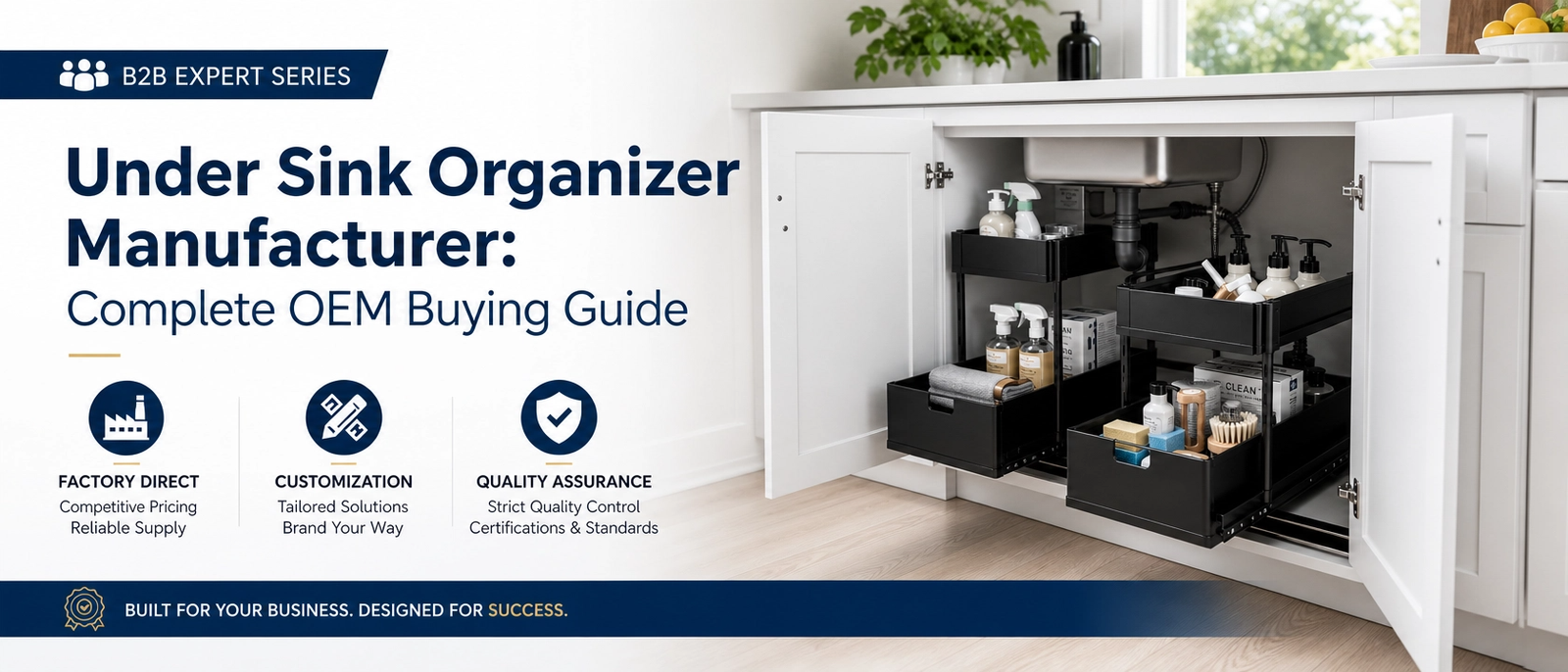
Under sink spaces are the hardest areas to organize in any kitchen. You're dealing with pipes, disposal units, curved walls, moisture, and awkward angles. That's why under sink organizers need specialized design—not just standard shelf racks painted white.
Under sink organizers require custom clearance cutouts for plumbing, corrosion-resistant finishes for damp environments, and adjustable configurations to fit various cabinet sizes. Generic storage racks fail because they can't adapt to these constraints.
Here's what I see all the time. A buyer sends us a photo of a nice-looking organizer from Amazon. They say "make this." We ask about pipe positions. They don't know. We ask about moisture exposure. They say "just make it like the photo."
Then we produce it. Their customer tries to install it. The middle shelf blocks the P-trap. Or the side panel sits right where the garbage disposal goes. The whole thing doesn't fit.
Key Design Differences
| Feature | Regular Storage Rack | Under Sink Organizer |
|---|---|---|
| Pipe Clearance | Fixed shelves, no cutouts | Adjustable panels with custom notches |
| Moisture Resistance | Basic powder coating | Enhanced anti-rust treatment |
| Installation | Simple assembly | Requires cabinet-specific fitting |
| Configuration | Static layout | Modular, removable components |
| Weight Distribution | Top-heavy design acceptable | Low center of gravity required |
I learned this lesson in 2018. We had a Dutch client who ordered 5,000 units. Beautiful product. Matte black finish. Sliding basket. Everything looked perfect in the warehouse. But they measured their target cabinet size wrong. Their customers had deeper sinks than expected. The organizer didn't fit 40% of installations. We had to redesign the depth, add extension pieces, and reproduce everything. Cost us three months and significant money.
That's when I realized—under sink products aren't furniture. They're solutions to specific spatial problems. Every cabinet is different. Every plumbing setup varies. A good manufacturer doesn't just make what you ask for. They ask questions first. What pipe diameter? What disposal unit brand? What cabinet depth range? What's the target market's most common sink configuration?
Critical Manufacturing Considerations
The material choice matters more than you think. Carbon steel is cheap but rusts fast in damp conditions. Stainless steel 3041 is ideal but expensive. Some manufacturers use iron with thick powder coating—good middle ground if the coating quality is high. We do 24-hour salt spray testing2 on all our under sink products. If the coating fails before 24 hours, we reject the batch.
The sliding mechanism is another hidden cost area. Cheap ball-bearing slides feel smooth in the showroom. But after 50 cycles with weight? They start catching. We use industrial-grade slides rated for 10,000+ cycles3. Yes, they cost more. But your customers won't return the product after six months.
And here's something most buyers never consider—the installation instructions. We include a drilling template and a magnetic level tool with our premium lines. Why? Because if installation is difficult, retailers get returns even when the product is perfect. We're not just selling hardware. We're selling a frustration-free customer experience.
How Do I Choose the Right Under Sink Organizer Manufacturer?
You need to evaluate five factory capabilities: custom design flexibility, finishing quality, load testing standards, MOQ practicality, and communication speed. Most manufacturers are good at one or two of these. You need all five.
The right manufacturer offers free 3D modeling, has in-house powder coating lines, provides load test reports, accepts reasonable starting quantities (500-1000 units for custom designs), and responds to your messages within 24 hours with technical answers—not just sales talk.
Last month I spoke with a Canadian buyer. He'd been working with a factory in Zhejiang for two years. The products were okay. Not great, but acceptable. His main complaint? Every time he wanted a small change—different hole spacing, slightly taller panel—the factory said "yes, yes" then delivered the old design. He'd go back and forth for weeks. Eventually he'd give up or accept what they made.
Manufacturer Evaluation Checklist
Here's my practical checklist. I use this when we audit potential partner factories for our own outsourcing needs:
Design Capability
- Can they modify CAD files based on your cabinet dimensions?
- Do they have an in-house design team or just sales staff?
- Will they provide 3D renderings before tooling?
- How many revisions are included in the quote?
Production Quality
- What's their salt spray test duration? (Minimum should be 24 hours)
- Do they have in-house powder coating or outsource it?
- What's their load testing standard? (We test at 25kg per shelf)
- Can you see their quality control process documentation?
Supply Chain Flexibility
- What's the realistic MOQ for a new custom design? (Be skeptical of "100 units"—that's often unrealistic for custom tooling)
- How do they handle reorders? (Stock your molds? Charge storage fees?)
- What's their lead time for sampling vs. bulk production?
- Do they offer packaging customization at reasonable quantities?
Communication Standards
- Do they assign you a dedicated project manager?
- Can they communicate in your language fluently?
- How fast do they respond to technical questions?
- Will they challenge your design if they see problems?
That last point is critical. A good manufacturer should push back sometimes. If you specify a 1.5mm wall thickness for a shelf that needs to hold 20kg, they should tell you that's insufficient. If they just say "yes" to everything, you'll have problems later.
Red Flags to Watch For
I've seen buyers waste months with the wrong factories. Here are the warning signs:
They send you catalogs instead of asking about your specific needs. That means they want you to pick from existing products—not truly customize. They avoid video calls. You ask for a factory tour via video, they make excuses. That often means they're trading companies, not manufacturers. They quote suspiciously low prices. If the price seems too good, they're either cutting corners on materials or planning to increase costs later with "unexpected" fees. They don't ask about your target market. Different regions have different standards. A manufacturer who doesn't ask about REACH compliance, CA Prop 654, or other regulations isn't thinking about your success.
We lost a potential client last year because our quote was 15% higher than another factory. Six months later, they came back. The cheaper factory delivered products that failed their retailer's quality audit. The powder coating chipped after minimal use. They had to scrap the entire shipment. Sometimes the "expensive" manufacturer is actually the cheaper choice in the long run.
Working with Chinese Manufacturers
Since most under sink organizer production happens in China, let me give you some insider perspective. We're based in Guangdong, which is the heart of kitchen hardware manufacturing. There are probably 200+ factories within 100km of us making similar products.
But here's what most buyers don't realize—those 200 factories have very different capabilities. Some are just assembly workshops. They buy components, put them together, and ship. Others like us have complete production lines. We do stamping, welding, powder coating, assembly, and packing all in-house.
Why does this matter? Control and consistency. When a factory outsources coating, they can't guarantee the quality. When they outsource welding, they can't adjust the process quickly. We run 9 production lines with about 100 pieces of equipment. If something needs adjustment, we do it immediately. We don't wait for a subcontractor to maybe make changes next week.
What Materials and Finishes Work Best for Under Sink Organizers?
Material selection directly impacts product lifespan and customer satisfaction. You're balancing cost, durability, and aesthetic appeal. The wrong choice means returns. The right choice means repeat orders.
For under sink organizers, carbon steel with quality powder coating offers the best cost-to-performance ratio. Stainless steel 304 is premium but increases cost by 40-60%. Aluminum works for lighter designs but limits load capacity. Each material requires specific finishing processes to handle moisture exposure.
I remember when powder coating was just white and black. Now we offer 15+ standard colors. Matte black is the most popular—probably 60% of our orders. Then matte white, cream white, and recently a lot of requests for sage green and dusty blue.
But here's what matters more than color—the coating thickness and curing process. We apply powder coating at 60-80 microns thickness5. Some factories do 40-50 microns to save material costs. That thinner coating looks fine initially. But it's more vulnerable to chips and moisture penetration.
Material Comparison Deep Dive
| Material | Cost Factor | Moisture Resistance | Load Capacity | Finishing Options | Best Use Case |
|---|---|---|---|---|---|
| Carbon Steel | 1.0x | Good (with coating) | Excellent (30kg+) | Powder coating, chrome plating | Standard retail products |
| Stainless Steel 304 | 1.6x | Excellent | Very Good (25kg+) | Satin, polished, electroplated | Premium lines, humid climates |
| Aluminum | 1.3x | Good | Moderate (15kg) | Anodized (black, silver, gold) | Lightweight designs |
| Chrome-Plated Steel | 1.4x | Very Good | Excellent (30kg+) | Chrome finish only | Classic/traditional styles |
We tested this systematically three years ago. We took identical designs and produced them in four materials. Then we ran accelerated aging tests—heat cycles, humidity exposure, weight stress6. The carbon steel with proper powder coating lasted just as long as stainless steel in normal kitchen conditions7. The difference only appeared in extreme humidity (like coastal areas) or if the coating got scratched.
That's why I always ask buyers: where's your target market? Germany? Northern Europe? Those kitchens are well-ventilated and dry. Standard powder coating works perfectly. Florida? Southeast Asia? Those are humid environments. Maybe consider stainless steel or thicker coating.
Finishing Process Details
Let me break down what actually happens in the finishing process. Most buyers just see the end result—they don't realize how many steps create that result.
Powder Coating Process:
- Metal preparation and degreasing (removes oils from stamping)
- Acid wash or sandblasting (creates surface texture for adhesion)
- Phosphate treatment (adds corrosion resistance base layer)
- Powder application (electrostatic spray8 at 60-80 microns)
- Curing in oven (usually 180-200°C for 15-20 minutes)
- Quality inspection (check for bubbles, thin spots, color consistency)
Each step affects the final durability. Skip the phosphate treatment9? You save 10 minutes and maybe $0.20 per unit. But moisture resistance drops significantly. We don't skip steps. Some factories do.
For stainless steel, the process is different. Satin finish comes from mechanical grinding with progressively finer abrasives. Polished finish requires buffing compounds and multiple polishing wheels. Electroplating adds a thin layer of another metal (gold, rose gold, gunmetal) for decorative effect.
I had an Australian buyer who wanted rose gold finish last year. Beautiful look. Very trendy. But I told him straight—that finish won't survive regular cleaning. It's electroplate over stainless steel. If customers use abrasive cleaners, the rose gold layer wears off in 6-12 months. For under sink use where people don't clean often? Probably okay. For countertop use? Not recommended. He appreciated the honesty. We did half his order in rose gold for display, half in practical matte black for actual use.
Load Capacity and Material Thickness
This is where material choice really matters. Under sink organizers need to hold cleaning supplies, which are heavy. A typical organization setup might include:
- Spray bottles (500g each × 4 = 2kg)
- Dish soap bottles (1kg × 2 = 2kg)
- Paper towels (500g)
- Garbage bags box (500g)
- Various sponges and brushes (1kg)
That's about 6-7kg per shelf, and customers often overload beyond recommendations. We design for 25kg per shelf to give safety margin.
Carbon steel at 0.8mm thickness works for shelves up to 35cm wide10. Beyond that, you need 1.0mm or add support ribs. Stainless steel can go slightly thinner—0.7mm works for similar spans because the material has better tensile strength11. Aluminum needs 1.2-1.5mm for the same application.
Some manufacturers use thinner material and add more cross-bracing. That works structurally but reduces usable space. Our approach is to use appropriate material thickness so we can minimize internal supports and maximize storage capacity.
How Should I Structure My First OEM Order?
Your first order with a new manufacturer is a test. You're not just buying products—you're evaluating a long-term partner. Structure it to minimize risk while gathering maximum information about their capabilities.
Start with 500-1000 units for custom designs or 300-500 units for modified standard products. Request pre-production samples, mid-production inspection access, and detailed quality control reports. Pay 30% deposit, 70% before shipping—standard terms that protect both parties. Build in buffer time for potential delays.
I see two common mistakes with first orders. Some buyers order too small—like 100 units of a custom design. The unit cost is high because tooling gets spread over fewer pieces. The manufacturer doesn't take it seriously because profit is minimal. You don't get their best attention.
Other buyers go too big—5,000 units right away. If something goes wrong (and it often does on first orders), you're stuck with huge inventory of defective or wrong-spec products.
Optimal First Order Structure
Here's what I recommend based on 17 years of working with new clients:
For Custom Designs:
- Minimum 500 units, ideally 800-1,000 units
- This quantity justifies tooling costs
- Enough volume to evaluate consistency
- Not so much that defects cause major losses
- Allows you to test market response before big commitment
For Standard Products with Minor Modifications:
- Minimum 300 units per SKU
- Can combine multiple SKUs to reach 1,000+ total units
- Faster production since tooling already exists
- Lower risk since the base design is proven
For Testing Manufacturer Capability:
- Order 2-3 different products if possible
- Tests their range and consistency
- Reveals if they're better at simple or complex items
- Shows how they handle multiple SKUs simultaneously
Payment Terms and Protection
We work with payment terms that protect both sides. Standard structure:
- 30% deposit after order confirmation
- 70% balance before shipping
Some buyers want to pay 100% after delivery. That's unrealistic for custom manufacturing. We need capital to buy materials and run production. Some manufacturers ask for 50% deposit—that's fine too if they're well-established.
Here's what I suggest: use the deposit negotiation to gauge factory flexibility. If they're rigid about 50% deposit for a $5,000 order, they might be difficult partners on other issues. If they're reasonable and explain their cash flow needs, that's a good sign.
For payment protection, most serious buyers use:
- Letter of Credit (L/C)12 for large orders ($50,000+)
- Alibaba Trade Assurance for medium orders
- PayPal or Wire Transfer with inspection rights for smaller orders
We accept all these methods. We've been doing this long enough that payment structure isn't our main profit source—it's repeat orders from satisfied customers.
Sampling Process
Never skip sampling.
"SAE 304 stainless steel - Wikipedia", https://en.wikipedia.org/wiki/SAE_304_stainless_steel. Type 304 stainless steel is an austenitic chromium-nickel alloy (18% chromium, 8% nickel) that forms a passive chromium oxide layer, providing corrosion resistance in many environments including moderate moisture exposure. Evidence role: mechanism; source type: encyclopedia. Supports: that 304 stainless steel has corrosion-resistant properties suitable for moisture exposure. Scope note: Performance varies with specific environmental conditions; 304 may experience corrosion in chloride-rich or highly acidic environments ↩
"Accelerated Corrosion Tests in Quality Labels for Powder Coatings ...", https://pmc.ncbi.nlm.nih.gov/articles/PMC8585214/. Salt spray testing (per ASTM B117 or ISO 9227) is an accelerated corrosion test method used to evaluate protective coatings on metal substrates, though test duration requirements vary by application and industry standards. Evidence role: general_support; source type: institution. Supports: that salt spray testing is a recognized method for evaluating corrosion resistance of coated metals. Scope note: Standards documents specify testing methodology but do not universally prescribe 24 hours as the minimum acceptable duration for all kitchen hardware applications ↩
"Best Ball Bearing Drawer Slide for Modern Furniture - DTC Hardware", https://www.dtcdtc.com/article/best-ball-bearing-drawer-slide-for-modern-furniture.html. Furniture hardware standards such as ANSI/BIFMA X5.9 specify cycle testing for drawer slides to evaluate operational durability, with requirements varying by furniture type and intended use intensity. Evidence role: general_support; source type: institution. Supports: that cycle testing is used to evaluate drawer slide durability in furniture applications. Scope note: The standard does not specifically define 10,000 cycles as the threshold for 'industrial-grade' classification in residential kitchen applications ↩
"Registration, Evaluation, Authorisation and Restriction of Chemicals", https://en.wikipedia.org/wiki/Registration,_Evaluation,_Authorisation_and_Restriction_of_Chemicals. REACH (Registration, Evaluation, Authorisation and Restriction of Chemicals) is European Union regulation EC 1907/2006 governing chemical substances in products, while California Proposition 65 requires warnings for products containing chemicals known to cause cancer or reproductive harm, both affecting manufacturing and import requirements. Evidence role: definition; source type: government. Supports: that REACH and Proposition 65 are regulatory frameworks affecting consumer product manufacturing. ↩
"Powder Coating Thickness: A Comprehensive Guide - Unionfab", https://www.unionfab.com/blog/2024/05/powder-coating-thickness. Powder coating thickness typically ranges from 50-100 microns for general industrial applications, with specific requirements depending on substrate, environment, and performance expectations per ISO 2360 and related standards. Evidence role: general_support; source type: institution. Supports: that coating thickness affects protective performance and is specified in finishing standards. Scope note: Standards provide ranges rather than prescribing 60-80 microns specifically for under-sink kitchen applications ↩
"Accelerated aging - Wikipedia", https://en.wikipedia.org/wiki/Accelerated_aging. Accelerated aging testing applies elevated stress conditions (temperature cycling, humidity, mechanical loading) to predict long-term product performance in compressed timeframes, with methodologies standardized in various ASTM, ISO, and IEC specifications depending on product category. Evidence role: general_support; source type: institution. Supports: that accelerated aging tests using environmental stressors are recognized methods for evaluating product durability. Scope note: Correlation between accelerated test results and real-world lifespan requires validation and depends on accurate stress modeling of actual use conditions ↩
"Corrosion protection performance of silicon-based coatings ... - PMC", https://pmc.ncbi.nlm.nih.gov/articles/PMC9131146/. Research on protective coatings indicates that properly applied organic coatings (including powder coatings) can provide corrosion protection approaching that of stainless steel in non-aggressive environments, though performance depends heavily on coating integrity and application quality. Evidence role: general_support; source type: research. Supports: that high-quality organic coatings can provide corrosion protection comparable to stainless steel in moderate environments. Scope note: Comparative performance is highly dependent on specific coating formulation, application process, and environmental conditions; coated carbon steel remains vulnerable if coating is breached ↩
"Powder coating - Wikipedia", https://en.wikipedia.org/wiki/Powder_coating. Electrostatic powder coating applies charged powder particles to grounded metal substrates using corona discharge or tribo-electric charging, causing particles to adhere via electrostatic attraction before thermal curing fuses them into a continuous film. Evidence role: mechanism; source type: encyclopedia. Supports: that electrostatic spray is the standard application method for powder coating. ↩
"The Formation Mechanism and Corrosion Resistance of a ... - PMC", https://pmc.ncbi.nlm.nih.gov/articles/PMC5872981/. Phosphate conversion coatings (typically zinc or iron phosphate) create a crystalline layer on metal surfaces that enhances paint adhesion and provides baseline corrosion resistance by acting as a barrier between the substrate and environment. Evidence role: mechanism; source type: encyclopedia. Supports: that phosphate conversion coatings improve corrosion resistance and coating adhesion. ↩
"Calculate deflection in a shelf made from sheet metal - Physics Forums", https://www.physicsforums.com/threads/calculate-deflection-in-a-shelf-made-from-sheet-metal.816855/. Shelf structural adequacy is determined by deflection limits and stress analysis based on material properties (yield strength, elastic modulus), thickness, span, support conditions, and applied loads, typically calculated using beam theory principles. Evidence role: mechanism; source type: education. Supports: that shelf load capacity depends on material thickness, span, and material properties. Scope note: The calculation does not validate the specific 0.8mm/35cm/25kg combination without knowing exact material grade, support configuration, and safety factors applied ↩
"SAE 304 stainless steel - Wikipedia", https://en.wikipedia.org/wiki/SAE_304_stainless_steel. Type 304 stainless steel typically has a tensile strength of 515-620 MPa and yield strength of 205-310 MPa, compared to mild carbon steel with tensile strength of 400-550 MPa and yield strength of 250-350 MPa, though specific values vary by grade and processing. Evidence role: statistic; source type: encyclopedia. Supports: the relative tensile strength of 304 stainless steel compared to carbon steel. Scope note: The comparison depends on specific steel grades; some carbon steels exceed 304 stainless in strength, and structural design must also consider elastic modulus and other factors beyond tensile strength alone ↩
"Letter of Credit - International Trade Administration", https://www.trade.gov/letter-credit. A Letter of Credit is a bank-issued guarantee that payment will be made to the seller upon presentation of specified documents proving shipment and compliance with terms, providing security to both parties by making the bank intermediary to the transaction per Uniform Customs and Practice for Documentary Credits (UCP 600). Evidence role: mechanism; source type: institution. Supports: that Letters of Credit provide payment security in international trade. ↩