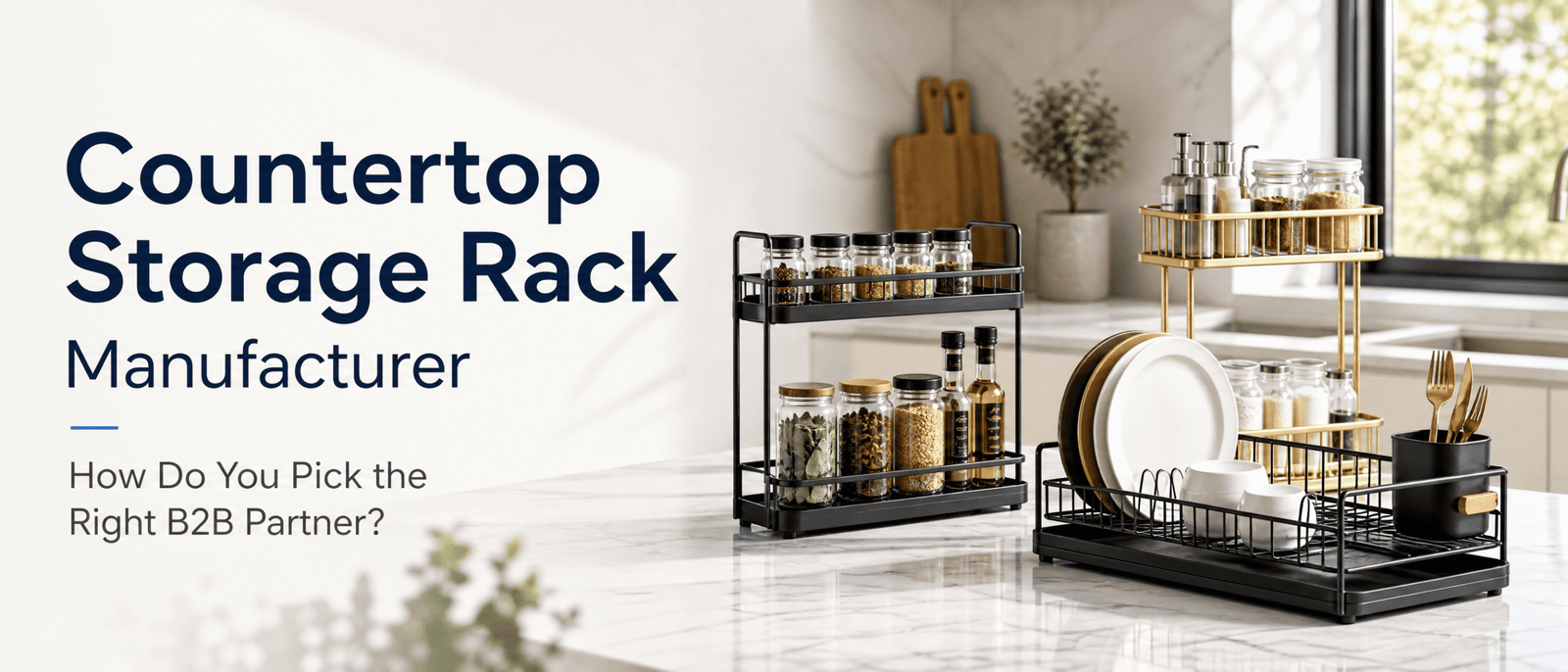
Countertop Storage Rack Manufacturer: How Do You Pick the Right B2B Partner?
If you've been burned by a supplier who delivered late, got the color wrong, or shipped you a product that looked nothing like the sample — you already know how expensive a bad choice can be.
Finding the right countertop storage rack manufacturer comes down to three things: customization capability, surface finish quality, and packaging flexibility. A supplier who can only offer standard sizes and colors will limit your ability to compete in today's market.
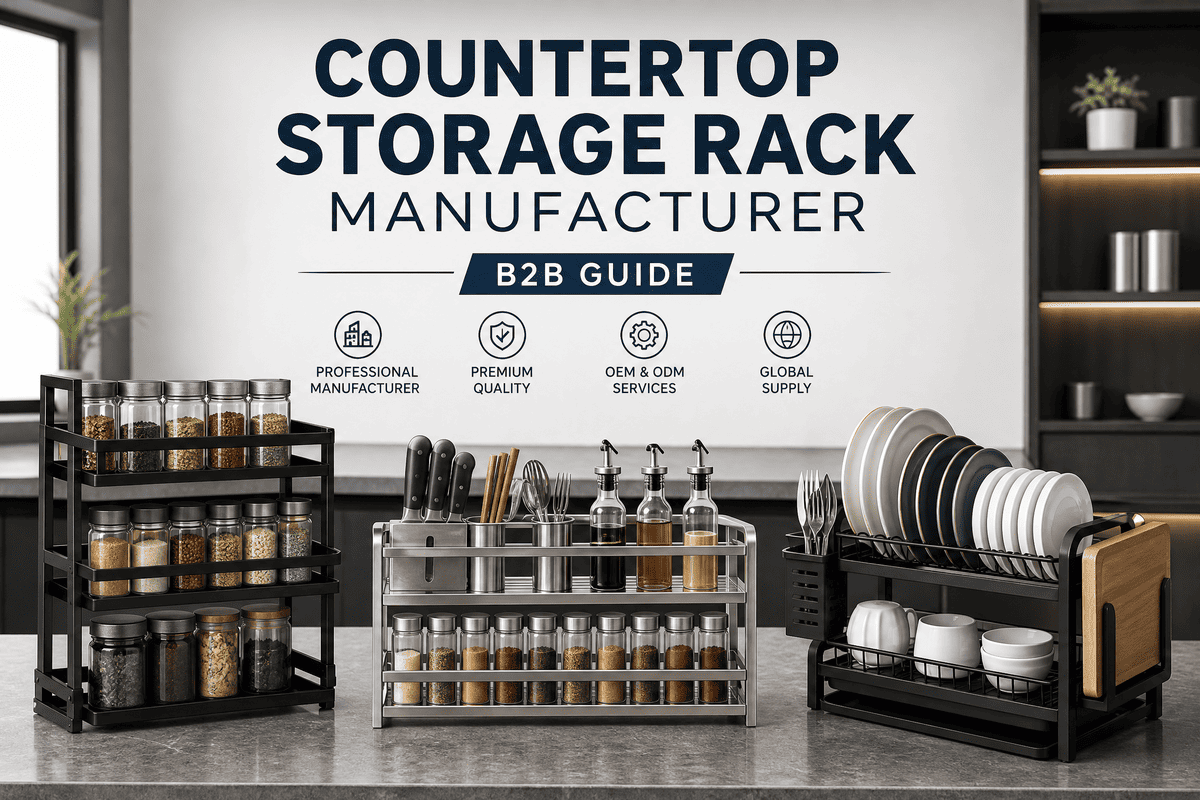
Most buyers start their search by comparing prices. That's a reasonable place to start. But price alone doesn't explain why some products sell consistently and others sit in a warehouse. The real difference is usually in the details — the finish, the dimensions, the way the product is packed. Let me walk you through what actually matters when you're choosing a manufacturer for countertop storage racks.
Is There Really That Much Difference Between Countertop Storage Rack Suppliers?
At first glance, most countertop storage racks look the same. You see the same wire grid shelves, the same basic shapes, the same standard sizes across dozens of catalogs. It's easy to assume the products are interchangeable.
But the competition between suppliers isn't really about shelf count. It's about dimensions, colors, surface finishes, packaging options, and how well a manufacturer can combine these elements into a product that fits your specific market.
Here's what I've seen after years of working with global buyers. The buyers who struggle to differentiate their products usually picked a manufacturer based on catalog images and unit price. They ended up with the same product as five other sellers on the same platform, competing purely on price. That's a race nobody wants to run.
The buyers who build real product lines — the ones with consistent reorders and growing retail presence — they ask different questions from the start. They ask: Can you adjust the depth by 20mm? Can you do this in matte black instead of chrome? Can we get a gift box version for the holiday season? These are not complicated requests. But not every factory can say yes to all of them.
What Makes a Product "Competitively Different"?
Let me break this down into the areas that actually drive purchasing decisions at the retail level.
| Differentiation Factor | Standard Supplier | Capable OEM Manufacturer |
|---|---|---|
| Dimensions | Fixed catalog sizes only | Adjustable to your spec |
| Color Options | Usually 1–2 (chrome, black) | Wide range incl. matte, pastels |
| Surface Finish | Basic powder coat or chrome | Multiple finishes, quality tested |
| Packaging | Plain brown box | Gift box, display tray, custom label |
| MOQ Flexibility | High MOQ on standard only | Lower MOQ on light customization |
When you look at it this way, you can see why two factories with similar-looking products are not actually offering the same thing. A factory that only sells off the shelf gives you convenience. A factory with real OEM capability gives you a product line.
Why Are Standard Countertop Racks So Hard to Compete With?
Standard countertop storage racks are everywhere. Malls, hardware stores, Amazon, Walmart — they all carry some version of the same basic product. The standard styles have been copied so many times that margins are thin and the market is crowded1.
Standard racks are competitive to manufacture but hard to sell at a profit. The buyers who are winning in this space are not selling standard products — they're selling lightly customized versions of standard products, with better colors, better packaging, or a detail that makes the product feel premium.
I talk to e-commerce sellers and brand buyers all the time who are tired of competing on price. They know their product is basically the same as their competitors. What they want is a version that looks and feels different enough to justify a slightly higher price point. This is where "light customization" becomes a real strategy.
Light customization doesn't mean a full product redesign. It means taking a proven structure and changing the things that are visible to the end consumer — color, surface texture, packaging, maybe a small dimension adjustment. These changes are affordable at scale, and they give your product a real identity.
How to Approach Light Customization Without Overcomplicating It
The trick is knowing what to customize and what to leave alone. Here's how I usually guide buyers through this thinking:
Start with color. Color is the single most powerful visual differentiator in kitchen hardware right now. Matte black, cream white, sage green, gunmetal, satin nickel — these finishes photograph well, they fit modern kitchen aesthetics, and they hold up over time with proper powder coating2. If your competitor is still selling chrome, switching to matte black alone can change how a buyer perceives the product's value.
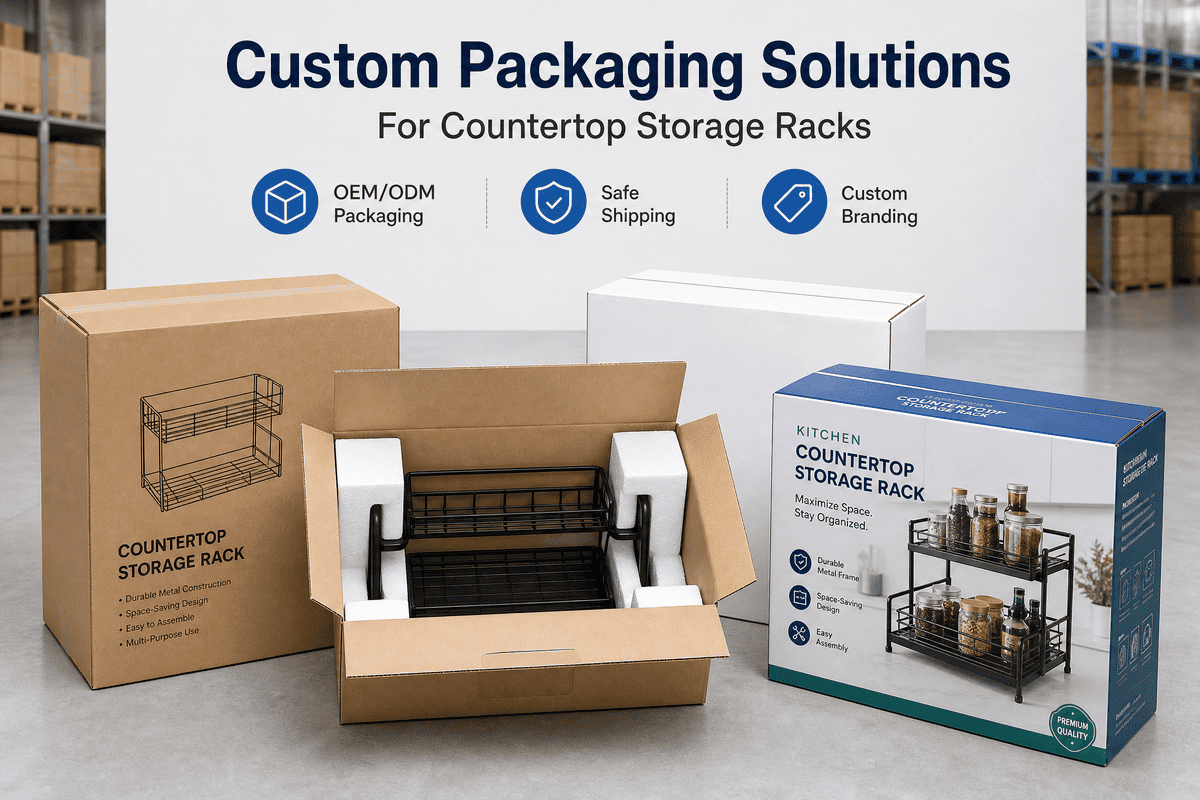
Then look at packaging. A standard product in a gift box sells differently than the same product in a plain brown box. If you're targeting retail or holiday gifting markets, packaging is not an afterthought — it's part of the product. A manufacturer who can offer white box with a color label, a gift box version, a display tray, and FBA-ready labeling all from the same factory is genuinely more useful to you.
Finally, consider dimensions. If your product is going into a specific retail shelf space or needs to meet a measurement that your customer has specified, dimension flexibility matters a lot. Not every factory can accommodate this without a tooling cost that makes no sense for your order size. Ask early.
| Customization Type | Typical Cost Impact | Time to Implement |
|---|---|---|
| Color change (powder coat) | Low | 1–2 weeks |
| Surface finish change | Low to medium | 2–3 weeks |
| Packaging change | Low | 1–2 weeks |
| Dimension change (within tooling) | Low to medium | 2–4 weeks |
| Full new mold / tooling | High | 4–8 weeks |
The good news is that most of what makes a product competitive sits in the first four rows of that table. You don't need a full custom design project to differentiate your product. You just need a manufacturer who has the range to support those options.
What Surface Finishes Actually Matter for Kitchen Storage Racks?
Surface finish is one of the most talked-about topics among buyers right now — and for good reason. The kitchen hardware market has shifted hard toward premium aesthetics.3 Consumers who used to accept chrome on everything are now paying attention to finish consistency, texture, and how a product fits into a designed kitchen space.4
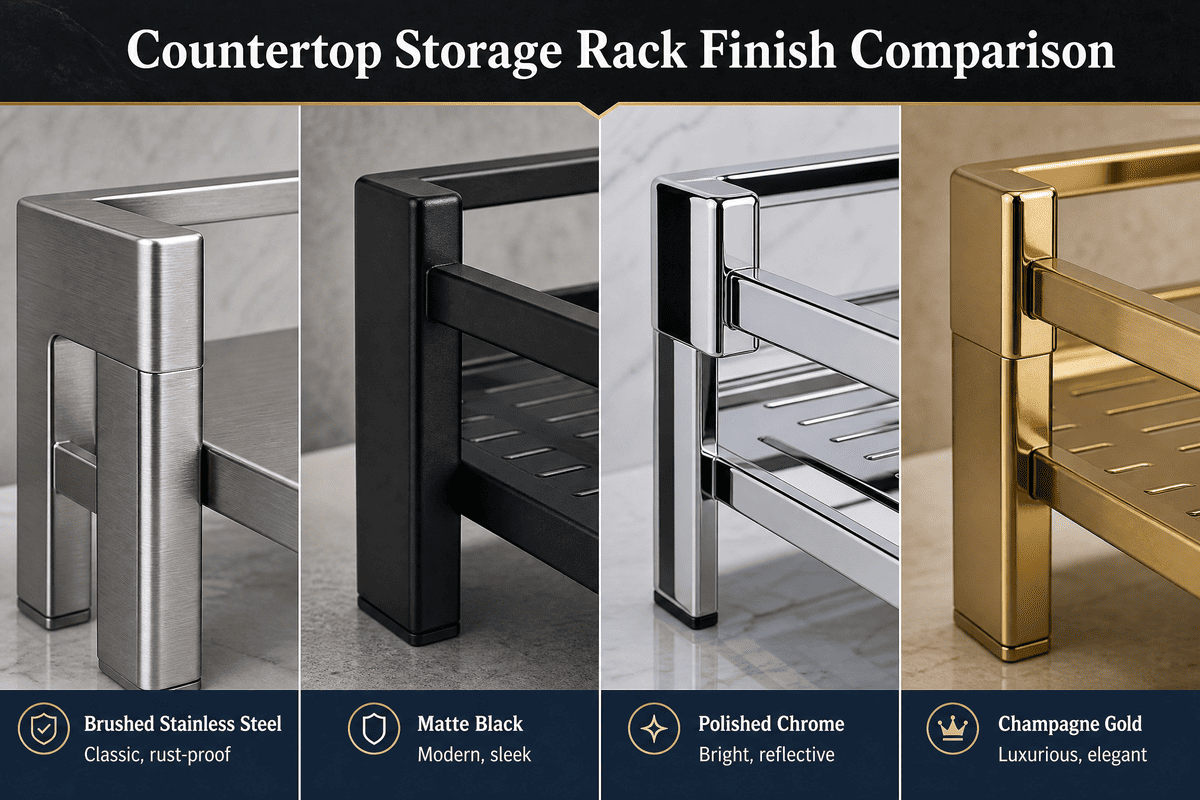
The most in-demand surface finishes for countertop storage racks today are matte black, matte white, cream white, satin nickel, and gunmetal.5 These finishes signal quality, photograph well for e-commerce, and fit the current design trend toward soft, non-reflective surfaces in kitchen environments.6
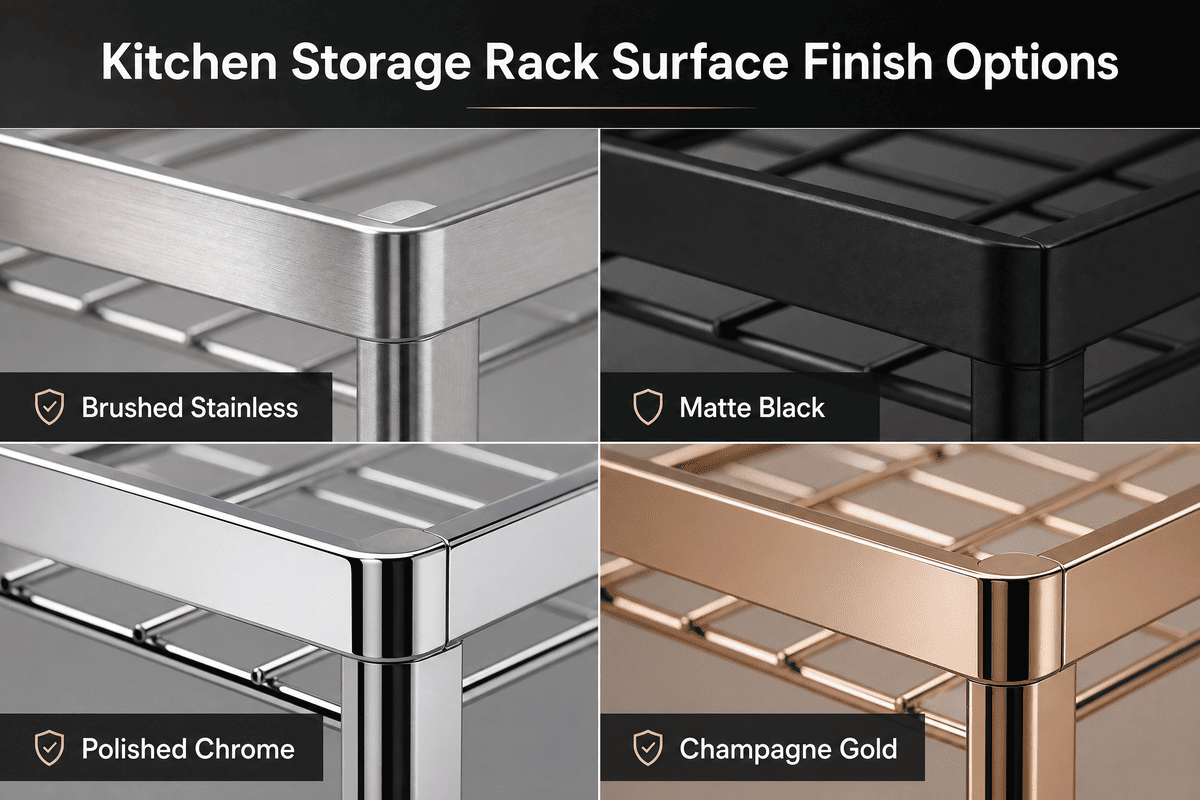
At our factory, we produce iron-frame products with powder coating in a full range of colors — white, black, matte black, matte white, onyx, red, cream white, green, and more. We also do chrome plating7 and specialty platings including gold, rose gold, gunmetal, and satin nickel. For stainless steel products, we offer satin and polishing finishes. For aluminum, we offer anodized8 silver, black, white, and accent colors.
This range matters because your customers in different markets have different preferences. A buyer sourcing for Scandinavian retail wants different aesthetics than a buyer sourcing for Southeast Asian e-commerce.9 A manufacturer with limited finish options forces you to choose from what they have. A manufacturer with real plating and coating capability lets you match the product to the market.
How to Evaluate Finish Quality Before You Order
Here's where a lot of buyers get burned. They see a nice product photo, they get a quote that looks good, and they skip the surface quality check. Then 5,000 units arrive with uneven coating, visible drips, or rust showing up after 30 days in storage10. That's a real scenario, not a hypothetical.
| Quality Check | What to Ask the Supplier |
|---|---|
| Salt spray test11 | Do you pass 24-hour salt spray test? (We do) |
| California Prop 6512 | Is the product CA65 compliant? (We test for this) |
| Coating thickness | What is your standard powder coat thickness? |
| Color consistency | Can you provide a color standard swatch for approval? |
| Finish durability | What is your process for adhesion testing? |
A serious manufacturer will answer all of these questions without hesitation. If a supplier becomes vague when you ask about testing, that's a signal worth paying attention to.
Conclusion
The right countertop storage rack manufacturer gives you more than a product — they give you a competitive tool. Focus on finishes, light customization options, and packaging flexibility, not just unit price.
"[PDF] Finding Sustainable Profitability in the E-commerce Continuum - MIT", https://web.mit.edu/jdefig/www/papers/ecommerce_continuum.pdf. Economic research on commodity markets demonstrates that product standardization and low barriers to entry typically result in price-based competition and compressed profit margins, a pattern observed across multiple retail categories. Evidence role: general_support; source type: research. Supports: margin pressure in undifferentiated commodity product categories. Scope note: General economic principles rather than specific data on countertop storage rack margins ↩
"Powder coating - Wikipedia", https://en.wikipedia.org/wiki/Powder_coating. Powder coating is an electrostatic finishing process where dry powder particles are applied to metal surfaces and cured under heat, creating a durable finish with advantages in uniformity and environmental impact compared to liquid coatings. Evidence role: mechanism; source type: encyclopedia. Supports: powder coating as a dry finishing process for metal products. ↩
"Cabinet Hardware Market Size & Share Report, 2035", https://www.businessresearchinsights.com/market-reports/cabinet-hardware-market-100679. Home improvement market analyses indicate increased consumer spending on premium-positioned kitchen and storage products, driven by home renovation trends and e-commerce growth, though specific hardware subcategory data varies by source. Evidence role: general_support; source type: research. Supports: growth in premium and design-focused segments of the home hardware market. Scope note: Broad home improvement trends may not precisely reflect the specific kitchen hardware storage rack segment ↩
"Effects of Design Aesthetics on the Perceived Value of a Product", https://pmc.ncbi.nlm.nih.gov/articles/PMC8359925/. Consumer behavior studies in home goods categories show growing emphasis on design coherence and aesthetic fit, particularly among millennial and Gen Z buyers influenced by social media and design content platforms. Evidence role: general_support; source type: research. Supports: increasing consumer attention to aesthetic factors in home product purchasing decisions. Scope note: General home goods consumer trends rather than specific longitudinal data on kitchen hardware finish preferences ↩
"Consumer knowledge of and engagement with traditional takeaway ...", https://pmc.ncbi.nlm.nih.gov/articles/PMC11920686/. Market research on kitchen hardware trends indicates growing consumer preference for non-reflective, matte finishes in neutral tones, though specific product category rankings vary by region and retail channel. Evidence role: general_support; source type: research. Supports: contemporary kitchen hardware finish preferences and market trends. Scope note: General kitchen hardware trends may not precisely reflect countertop storage rack preferences specifically ↩
"Embracing the Future: 2024 Kitchen Design Trends", https://www.bellevuebuilders.com/embracing-the-future-2024-kitchen-design-trends/. Interior design publications and consumer surveys document a multi-year trend favoring matte and low-sheen finishes in kitchen spaces, associated with minimalist and Scandinavian-influenced aesthetics. Evidence role: expert_consensus; source type: research. Supports: the shift toward matte and non-reflective finishes in contemporary kitchen design. ↩
"Chrome plating - Wikipedia", https://en.wikipedia.org/wiki/Chrome_plating. Chrome plating, or chromium electroplating, deposits a thin layer of chromium onto metal substrates through electrochemical reduction, providing corrosion resistance and a reflective finish commonly used in decorative and functional applications. Evidence role: mechanism; source type: encyclopedia. Supports: chrome plating as an electrochemical surface finishing process. ↩
"[PDF] Process Specification for the Anodizing of Aluminum Alloys - NASA", https://www.nasa.gov/wp-content/uploads/2023/03/prc-5006-current.pdf. Anodizing is an electrochemical process that converts the aluminum surface into a durable, corrosion-resistant anodic oxide finish, which can be dyed in various colors and provides enhanced wear resistance compared to untreated aluminum. Evidence role: mechanism; source type: encyclopedia. Supports: anodizing as an electrochemical process for aluminum surface treatment. ↩
"Effects of Design Aesthetics on the Perceived Value of a Product", https://pmc.ncbi.nlm.nih.gov/articles/PMC8359925/. Cross-cultural consumer research documents significant regional differences in color preferences, material associations, and design aesthetics, influenced by cultural values, climate, and local design traditions. Evidence role: general_support; source type: research. Supports: regional variation in design preferences and aesthetic values across consumer markets. Scope note: General cross-cultural research rather than specific data on storage product preferences by region ↩
"Failure Mechanisms of the Coating/Metal Interface in Waterborne ...", https://pmc.ncbi.nlm.nih.gov/articles/PMC5506901/. Corrosion science literature indicates that inadequate coating thickness, poor surface preparation, or coating defects can allow moisture penetration and initiate rust formation in ferrous metals within weeks under humid conditions. Evidence role: mechanism; source type: research. Supports: the relationship between coating quality and corrosion protection timeframes. Scope note: Specific corrosion timelines depend on multiple environmental and material factors beyond coating quality alone ↩
"Salt spray test - Wikipedia", https://en.wikipedia.org/wiki/Salt_spray_test. ASTM B117 establishes standardized procedures for salt spray testing of coated metals, with test durations varying by application requirements and performance specifications. Evidence role: definition; source type: institution. Supports: salt spray testing as a standardized corrosion resistance evaluation method. Scope note: Standard test durations vary by industry and application; 24 hours represents one common benchmark among several ↩
"The Proposition 65 List - OEHHA - CA.gov", https://oehha.ca.gov/proposition-65/proposition-65-list. California's Safe Drinking Water and Toxic Enforcement Act of 1986 (Proposition 65) requires warnings for products containing chemicals known to cause cancer or reproductive harm, with specific limits for substances including lead and cadmium commonly found in metal coatings. Evidence role: definition; source type: government. Supports: California Proposition 65 as a regulatory framework requiring warnings for products containing certain chemicals. ↩