
Kitchen Storage Product Trends for Wholesale Buyers
When you think about kitchen storage trends, what comes to mind first? Viral products dominating social media or eye-catching designs on Pinterest? For wholesale buyers, this focus on retail hype can be misleading, leading to inventory bottlenecks or costly missteps.
The key to navigating kitchen storage product trends is understanding which trends are feasible for large-scale production. Feasibility depends on MOQ (minimum order quantities)1, tooling investments2, certification, and customization costs3—factors that are often overlooked in viral product discussions.

Retail trends might look attractive, but wholesale success requires analyzing production scalability. By the end of this article, you'll rethink which trends are worth committing to and avoid costly product development pitfalls.
How do retail trends mislead wholesale buyers?
It’s exciting to see a new product go viral online, but wholesale buyers must be cautious. Misjudging consumer trends often leads to two key problems: overproducing products that fade as fast as they rise and overlooking fundamental shifts in buyer needs like material compliance or modularity.
Retail hype often focuses on aesthetics or one-time use cases. Yet manufacturers must consider scalability, certification, and batch production timelines before offering a new SKU. Many viral trends fail these supply-side filters.
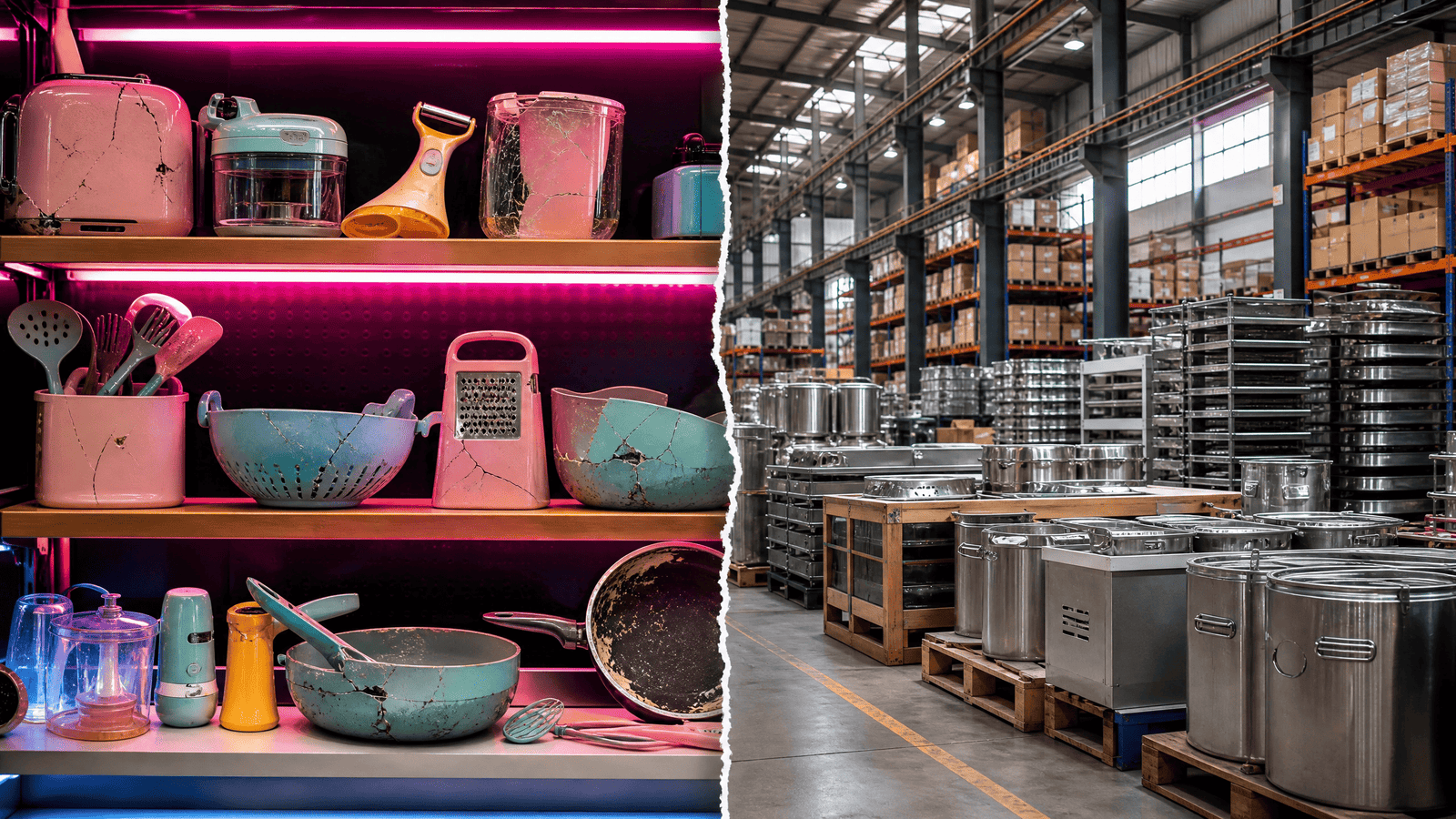
To make better decisions, consider products with long-term demand and repeatable use. A fashionable color may generate short-term sales, but sustainable growth depends on evergreen features like durability and ease of use4.
What insights can factories provide about trends?
Have you ever wondered how manufacturers recognize trends before they’re public knowledge? It’s not through surveys or market research—it's through clusters of similar orders from distributors across regions.
Factories identify trends when they see repeat requests for specific modifications or features across multiple markets5. When three or more distributors independently request magnetic knife holders with bamboo finishes6, it signals a structural shift in demand, not just a passing fad.

For buyers, this means aligning product development with confirmed production patterns. Before jumping on a trend, ask your supplier whether they’ve seen consistent interest in that product category from other clients. The answer will tell you whether it’s worth the investment.
How do you evaluate a production-ready trend?
We have all experienced moments of hesitation when debating whether to invest in new tooling or adapt existing molds. This decision point determines whether a trend is executable or unscalable.
The simplest way to evaluate a trend is to assess whether its adaptation requires significant structural redesign or can be implemented with surface-level changes. For instance, a new knife holder design might succeed by modifying materials (e.g., stainless steel vs. bamboo) rather than creating entirely new molds.

Breaking down cost structures is essential here. A bamboo finish might increase costs slightly but avoids heavy tooling investments7. On the other hand, a multi-tier rolling cart with unique weight capacity needs new engineering8, driving up MOQ and lead times. For buyers, understanding cost thresholds minimizes surprises.
What questions should wholesale buyers ask?
Trendy products can be tempting, but buyers need the right questions to filter good opportunities from risky launches. Have you ever added a product that didn’t sell simply because it looked like a hot item? Avoid this mistake by using a supplier-side lens.
Ask critical questions like: Can this concept be adapted with existing tooling? Are similar products receiving compliance-related inquiries9? What’s the average lead time when modifying finishes or dimensions? These inquiries uncover hidden costs and reduce risks.

Tables can help structure these questions and answers clearly.
| Question | Why It Matters | Potential Outcome |
|---|---|---|
| Can existing tooling be adapted? | Avoids mold investment costs | Cost savings on development |
| Are similar products gaining traction? | Confirms scalable demand across regions | Informs MOQ decisions |
| What is the lead time for modifications? | Identifies realistic production schedules | Prevents delays in product rollout |
| Does the product meet compliance standards? | Ensures smooth cross-border distribution10 | Avoids certification bottlenecks |
Are some trends inherently riskier than others?
Not all trends are created equal. Some have naturally predictable growth, while others carry high uncertainty. Do you know which features can indicate long-term demand versus short-lived attraction?
For example, modular kitchen storage units fulfill a functional need and align with space-saving trends11—making them a safe bet. But a product relying on trend-dependent aesthetics such as neon coloring can fizzle when the fad fades.

Focus on "evergreen" features that deliver real value. Go for products that solve problems, not just add visual appeal. Trends like multi-functional storage carts hit multiple needs at once, from mobility to storage, giving them a longer market life.
Conclusion
To succeed with kitchen storage trends, wholesale buyers must move beyond retail hype. Focus on scalability, feasibility, and repeatable demand across markets. Filtering trends through production and supply chain data minimizes risk and ensures better decision-making.
"Minimum Order Quantity (MOQ): Formula, Tips, & Benefits | NetSuite", https://www.netsuite.com/portal/resource/articles/inventory-management/minimum-order-quantity-moq.shtml. Minimum order quantity (MOQ) represents the lowest number of units a manufacturer will produce in a single production run, directly affecting per-unit costs through economies of scale and tooling amortization. Evidence role: definition; source type: education. Supports: MOQ as a standard manufacturing constraint affecting production feasibility. Scope note: General manufacturing principle; specific MOQ impacts vary by product category and manufacturer capabilities ↩
"[PDF] TOOLS FOR ASSESSING ECONOMIC IMPACT: A PRIMER FOR ...", https://www.canr.msu.edu/foodsystems/uploads/files/tools-for-assessing-economic-impact.pdf. Tooling costs for injection-molded consumer products typically range from thousands to hundreds of thousands of dollars depending on complexity, representing a substantial upfront investment that must be amortized across production volumes. Evidence role: statistic; source type: education. Supports: The financial significance of tooling as a barrier to new product development. Scope note: Cost ranges vary significantly by product complexity, materials, and manufacturing location ↩
"Testing & Certification | CPSC.gov", https://www.cpsc.gov/Business--Manufacturing/Testing-Certification. Consumer products, particularly those intended for food contact, must meet safety standards established by regulatory bodies such as the FDA in the United States or equivalent agencies in other markets, requiring testing and documentation that adds to development timelines and costs. Evidence role: general_support; source type: government. Supports: Regulatory certification as a necessary compliance step for consumer products. Scope note: Specific requirements vary by product category, materials used, and target markets ↩
"Linking product design and durability: A review and research agenda", https://pmc.ncbi.nlm.nih.gov/articles/PMC9513616/. Consumer behavior research consistently identifies functional attributes such as durability and usability as primary drivers of repeat purchases and long-term product success, particularly in utilitarian product categories where performance outweighs aesthetic considerations. Evidence role: expert_consensus; source type: research. Supports: Functional attributes as drivers of sustained product demand. Scope note: Relative importance of functional versus aesthetic attributes varies by product category and consumer segment ↩
"A Guide to Demand Forecasting in Supply Chain Management", https://haslam.utk.edu/gsci/news/guide-to-demand-forecasting-in-supply-chain/. Supply chain research indicates that manufacturers often use aggregated order patterns and repeat customer requests as early indicators of market trends, allowing them to identify demand shifts before they become widely recognized in retail markets. Evidence role: mechanism; source type: research. Supports: Pattern recognition in order data as a demand forecasting method. Scope note: This represents one of multiple trend identification methods; effectiveness depends on customer diversity and market coverage ↩
"[PDF] EMPIRICAL STUDIES OF DEMAND SIGNAL PROCESSING IN ...", https://stacks.stanford.edu/file/druid:wf340ms2511/dis_d-augmented.pdf. Market research methodology suggests that convergent signals from independent sources provide stronger evidence of genuine demand patterns than isolated requests, though specific thresholds vary by market size and customer base diversity. Evidence role: general_support; source type: research. Supports: Multiple independent signals as indicators of genuine market trends. Scope note: The article's specific threshold of three requests is illustrative rather than based on cited statistical validation ↩
"Is Additive Manufacturing an Environmentally and Economically ...", https://pmc.ncbi.nlm.nih.gov/articles/PMC10134501/. In manufacturing, surface-level modifications such as material finishes or coatings typically require minimal changes to core tooling compared to structural redesigns, as they affect post-molding processes rather than the fundamental mold geometry. Evidence role: mechanism; source type: education. Supports: Surface treatments as lower-cost modifications compared to structural redesign. Scope note: Actual tooling impact depends on specific manufacturing processes and whether material changes affect structural requirements ↩
"[PDF] MECHANICAL DESIGN CALCULATIONS ASME Vlll DIV.2 2001 ...", https://downloads.regulations.gov/PHMSA-RSPA-2002-12806-0006/attachment_1.pdf. Products with specified load-bearing or weight capacity requirements must undergo structural engineering analysis to ensure material selection, geometry, and reinforcement meet performance criteria, often necessitating custom tooling when requirements differ from existing designs. Evidence role: mechanism; source type: education. Supports: Structural performance requirements as drivers of engineering complexity. Scope note: Engineering requirements vary based on safety standards, intended use cases, and liability considerations in target markets ↩
"A Guide to Demand Forecasting in Supply Chain Management", https://haslam.utk.edu/gsci/news/guide-to-demand-forecasting-in-supply-chain/. Supply chain management research suggests that increases in compliance-related inquiries from buyers can signal emerging regulatory requirements or market access barriers, providing manufacturers with advance notice of necessary product adaptations. Evidence role: general_support; source type: research. Supports: Customer compliance questions as early indicators of regulatory shifts. Scope note: Inquiry patterns must be distinguished from routine due diligence; significance depends on inquiry volume and geographic distribution ↩
"Harmonized Tariff Schedule - International Trade Commission", https://hts.usitc.gov/. International trade in consumer goods requires compliance with destination market regulations, including safety standards, labeling requirements, and material restrictions, which vary by jurisdiction and can create significant barriers to cross-border distribution when products fail to meet multiple regulatory frameworks. Evidence role: general_support; source type: institution. Supports: Regulatory compliance as a prerequisite for international market access. Scope note: Specific requirements vary widely by product category and destination market; some sectors have harmonized standards while others remain fragmented ↩
"How the Nation's Housing Changed in 20 Years - Census Bureau", https://www.census.gov/library/stories/2025/09/20-years-housing.html. Housing market trends in urban areas show decreasing average living space per capita in many developed markets, creating sustained demand for space-efficient storage solutions and multi-functional furniture that maximizes utility in constrained environments. Evidence role: historical_context; source type: research. Supports: Space constraints as a driver of storage product demand. Scope note: Trend magnitude varies significantly by geographic region and housing market conditions ↩