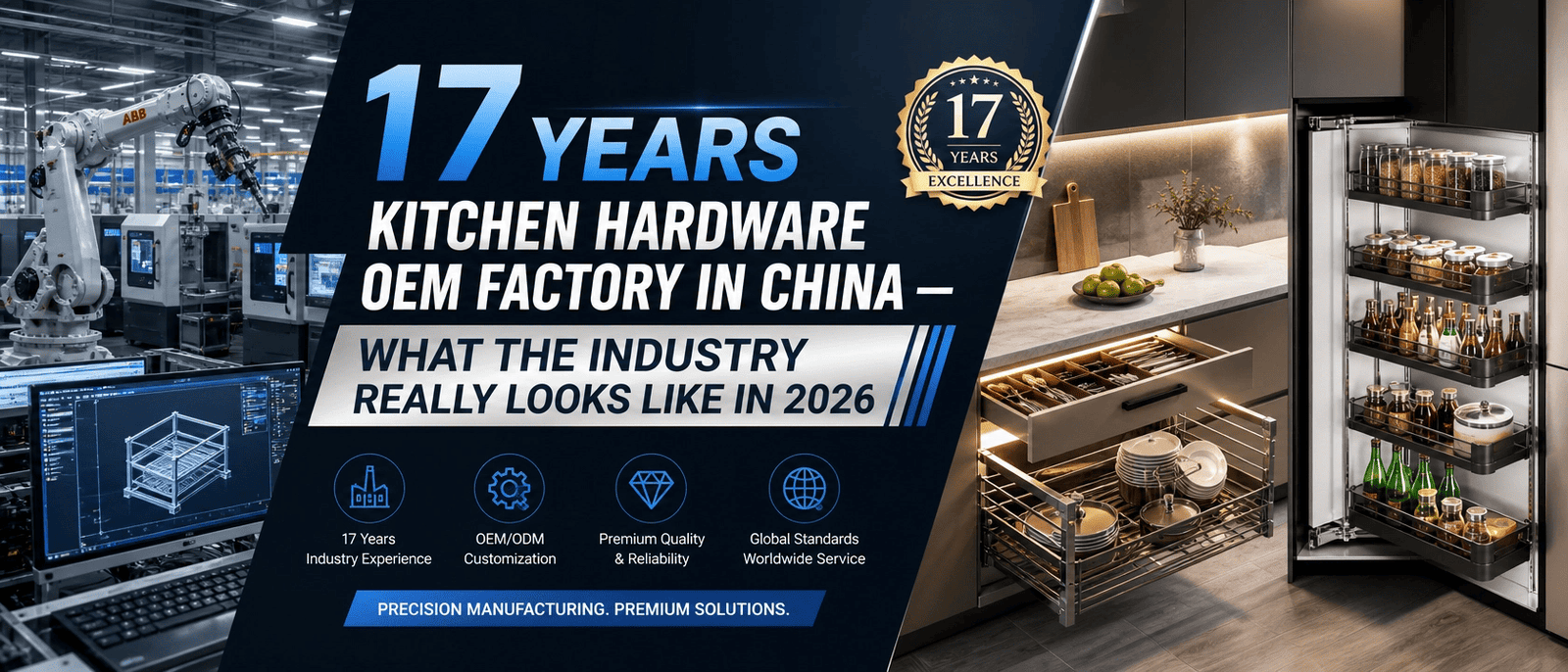
17 Years Kitchen Hardware OEM Factory in China — What the Industry Really Looks Like in 2026
If you are an importer, a brand owner, or an Amazon seller looking to source kitchen storage products, you have probably asked yourself some version of this question:
"Should I still source from China, or should I look at Vietnam, Mexico, or somewhere else?"
After 17 years of manufacturing kitchen hardware in Jiangmen, Guangdong — serving international brands, distributors, and private-label sellers across North America, Europe, and beyond — we think we are in a unique position to answer that question honestly.
Not as a sales pitch. As a factory that has watched this industry change from the inside.
Here is what the kitchen hardware supply chain actually looks like in 2025.
China Still Makes the World's Kitchen Hardware — Here Is the Data
Let's start with the foundation.
Approximately 65–70% of the world's kitchen storage and organization hardware — dish racks, bread boxes, knife holders, under-sink organizers, rolling carts, and related products — is manufactured and exported from China.
This is not a coincidence. It is the result of decades of industrial development concentrated in three main regions:
- Guangdong Province (Jiangmen, Zhongshan, Foshan, Shunde) — stainless steel wire products, surface-treated hardware, kitchen organizers
- Zhejiang Province (Yongkang, Cixi) — metal household products, storage systems
- Hebei Province (Anping) — wire mesh and welded wire products
Within Guangdong, Jiangmen has emerged as one of the most important production centers for stainless steel kitchen hardware. The reason is not just labor or land cost — it is the complete industrial ecosystem that surrounds it.
Within a 150-kilometer radius of our factory in Longan Industrial Zone, Duruan Town, you will find:
- Steel wire and sheet metal suppliers fed by Foshan, China's largest steel processing hub1
- Injection molding clusters in Zhongshan and Shunde supplying plastic trays, handles, and components
- Surface treatment facilities (electroplating, powder coating, spray coating) concentrated locally in Jiangmen
- Packaging material suppliers distributed throughout the Pearl River Delta
- Export logistics via Guangzhou Nansha Port and Shenzhen Yantian Port, both within 2–3 hours
The result is a supply chain that no other country has been able to replicate at scale. When a new product needs to be developed, we can source prototype materials, run tooling, complete surface treatment, and ship samples — all within the same industrial ecosystem.
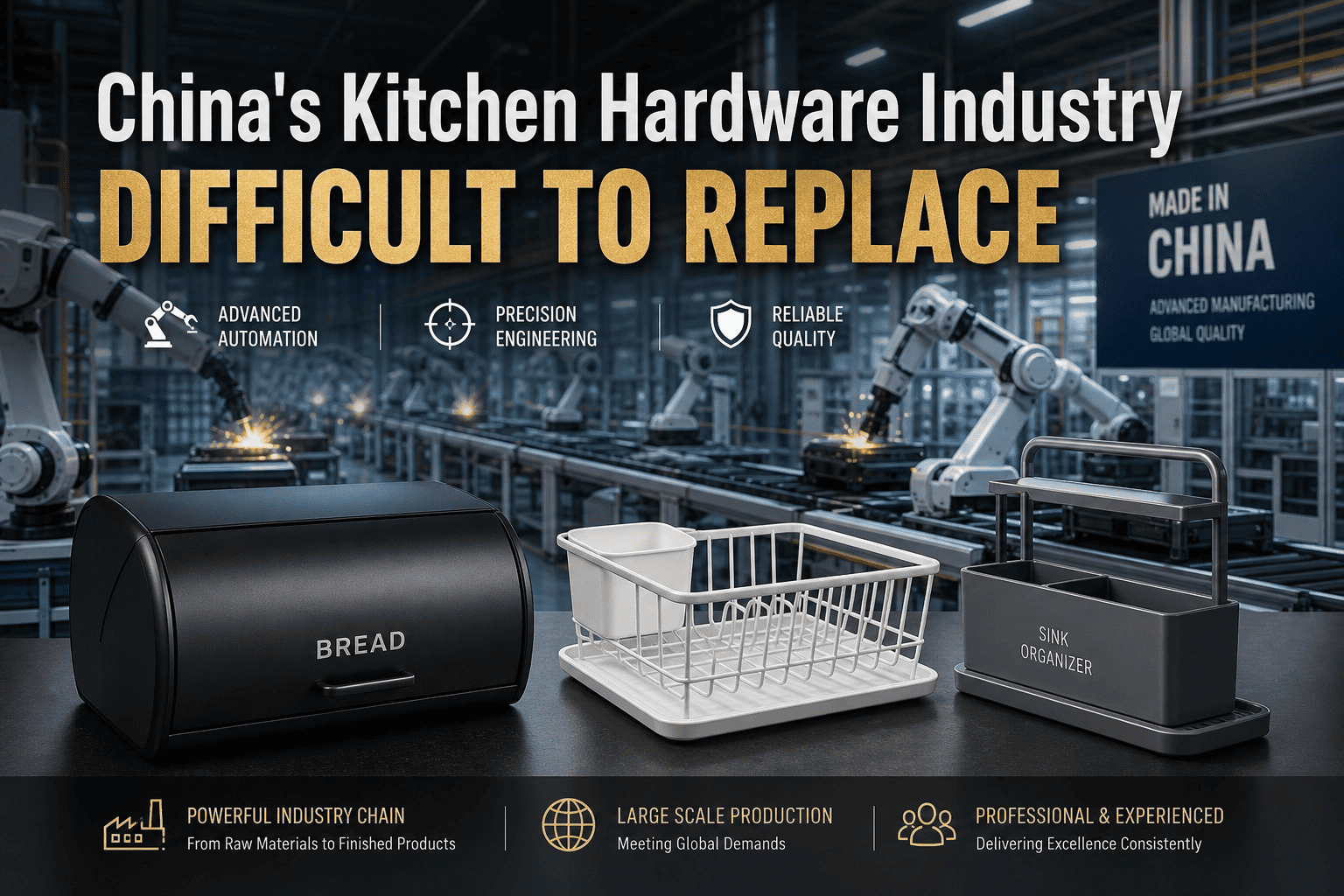
That kind of integrated capability is what makes China's kitchen hardware industry difficult to replace, even in 2026.
What the 2018 Trade War Actually Did to Kitchen Hardware Supply Chains
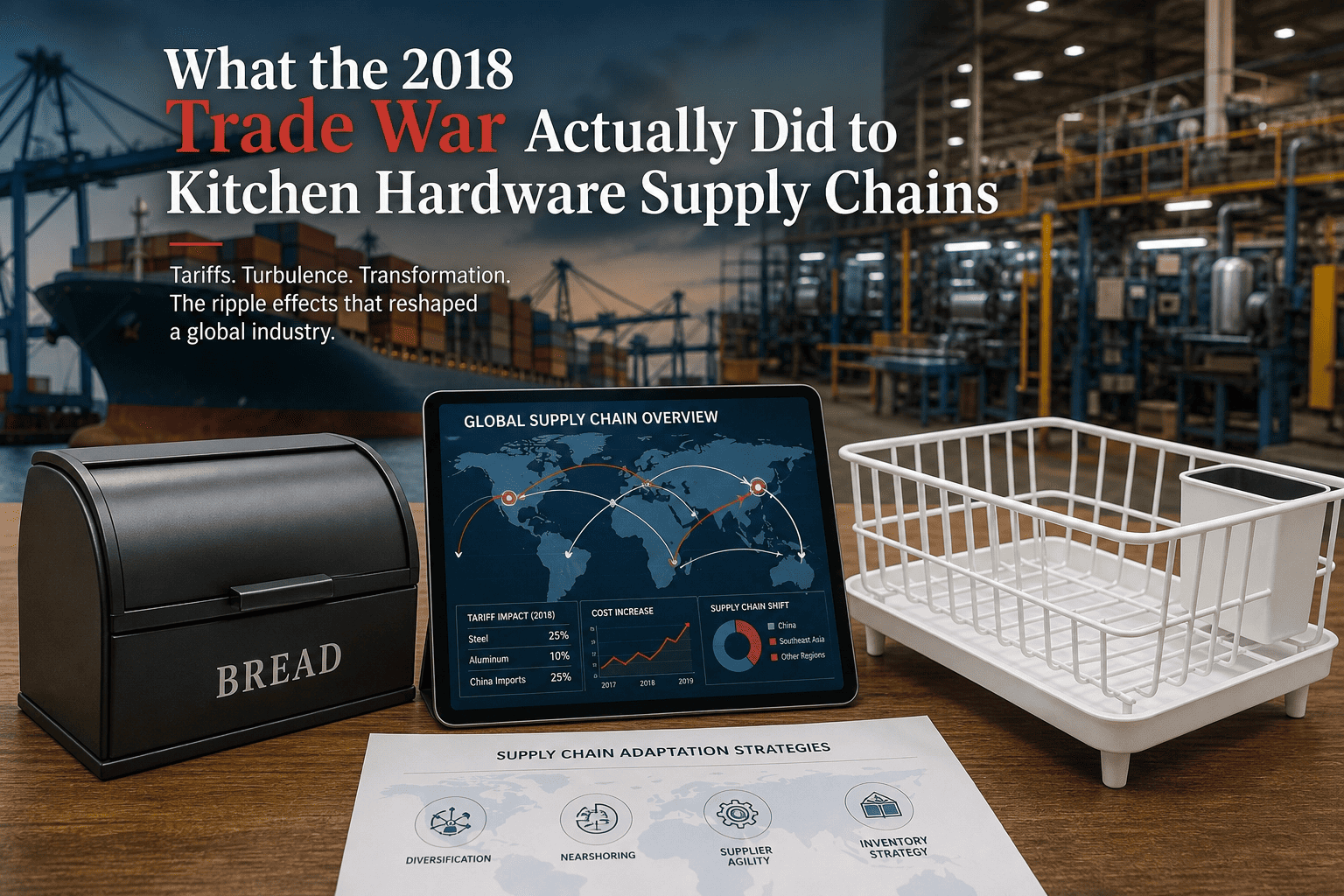
In 2018, the first round of US-China tariffs changed the calculation for many importers overnight.
Kitchen storage and organization products — previously subject to import duties of 0% to 3.7% entering the United States — suddenly faced Section 301 tariffs of 25% on top of existing rates. For products with thin retail margins, this was a serious problem.
The United States is the single largest market for kitchen storage products globally, accounting for an estimated 40–50% of total import volume. Walmart, Target, Amazon, TJ Maxx, and the broader US home goods retail channel collectively represent enormous purchasing power — and the tariff shock triggered immediate reactions across the supply chain.
What happened next was predictable: factories started looking at alternative manufacturing locations.
Vietnam became the primary destination for capacity relocation, for several reasons:
- Geographic proximity to Chinese raw material suppliers
- Lower labor costs than China
- Existing garment and electronics manufacturing infrastructure
- Preferential trade agreements with the US and EU
Between 2018 and 2023, a meaningful number of basic kitchen hardware assembly operations — particularly for simple wire racks, shopping baskets, and standard dish racks — shifted toward Vietnam, with smaller flows going to Malaysia, Bangladesh, and Mexico.
For importers who primarily needed standard, high-volume, price-sensitive products destined for the US market, this shift made short-term financial sense.
But the story did not end there.
The Vietnam Factory Reality — Why Components Still Come From China
Here is what most trade publications do not tell you about the "Made in Vietnam" kitchen hardware supply chain.
The factories moved. The supply chain did not.
When we talk to importers who have worked with Vietnamese kitchen hardware factories, the same pattern emerges consistently. The assembly location changed, but the critical inputs still come from China:
- Stainless steel wire and sheet metal — Vietnam does not have a domestic stainless steel industry capable of supplying kitchen hardware at scale. Wire coils and sheet material are imported from China and South Korea, with China dominating on cost.
- Plastic injection-molded components — PET drip trays, PP handles, ABS knobs — the tooling expertise and production scale for these parts remain concentrated in the Pearl River Delta. Vietnamese injection molding capacity exists, but for complex or tight-tolerance parts, Chinese suppliers remain the default.
- Surface treatment — Powder coating, spray coating, and electroplating for kitchen hardware requires significant investment in facilities and environmental compliance infrastructure. Many Vietnamese factories either outsource this to China or operate with lower-quality local alternatives.
- Mold development — For any product requiring custom tooling, molds are almost always developed in China (Guangdong or Zhejiang) and then shipped to Vietnam for production runs.
The practical consequence is that the total landed cost of kitchen hardware from a Vietnam-based assembly factory is typically 8–15% higher than sourcing the same product directly from a Chinese manufacturer2 — once you account for component import costs, longer development lead times, and quality management complexity across two countries.
Vietnamese factory labor costs are lower, approximately 30–40% below comparable Chinese rates3. But labor is only one input in a product like a dish rack or a bread box. Material cost, tooling amortization, surface treatment, quality control, and logistics all factor into the final price — and China maintains structural advantages in most of these categories.

The honest summary: "Made in Vietnam" kitchen hardware is, in most cases, engineered in China, made from Chinese components, and assembled in Vietnam. For an importer trying to manage costs, this matters.
2026 Tariffs and the China+1 Strategy — What It Means for Your Sourcing
The trade environment in 2025 has added a new layer of complexity.
With tariff rates on Chinese goods under discussion at levels significantly higher than the 2018–2019 Section 301 rates, importers are once again reassessing their supply chain strategies. The uncertainty itself — regardless of the final outcome — is pushing some buyers to accelerate the diversification they started in 2018.
For the kitchen hardware category, we expect the following to play out:
Products most likely to shift further toward Southeast Asia:
- Standard wire dish racks with no customization
- Basic shopping baskets and utility carts
- Simple under-sink organizers with commodity specifications
These are products where the design is fixed, tooling investment is minimal, assembly is labor-intensive, and price is the primary purchase driver. For these SKUs, Vietnam or Bangladesh assembly makes increasing sense as tariff pressure rises.
Products that will remain China-based:
- OEM/ODM new product development
- Products requiring complex surface treatments (multi-step electropolishing, specialized coatings)
- Items requiring US or EU market certifications (CA Prop 654, LFGB5, REACH6, FDA)
- Customized configurations — custom dimensions, proprietary packaging, brand-specific tooling
- Higher-value products where quality consistency is non-negotiable
The emerging model is what the industry calls China+1: China handles engineering, tooling, complex component production, and certification; a second country handles final assembly and labeling for tariff purposes.
Our honest advice to importers navigating this environment:
If you need standard products at the lowest possible unit cost and your primary market is the United States, a China+1 strategy may reduce your tariff exposure. But structure it carefully — ensure your Vietnamese or Mexican assembly partner has a verified Chinese supply chain behind it, not an improvised local one.
If you need custom products, new product development, private-label differentiation, or any form of certification compliance, work directly with a Chinese factory that has the engineering depth to support it. The capabilities required for real OEM/ODM work — tooling, prototyping, material expertise, testing — are not yet replicable at scale outside of China.
Our Factory in 2026 — By the Numbers
We believe transparency builds better business relationships. Here is what our operation looks like today:
| Metric | Detail |
|---|---|
| Years in operation | 17 years |
| Production lines | 9 lines |
| Equipment units | 100+ machines |
| Packing lines | 6 lines |
| Daily output capacity | 4,000 sets/day |
| Certifications | CA Prop 65 compliant |
| Corrosion testing | 24-hour salt spray test7 passed |
| Business model | B2B only — OEM/ODM, wholesale, private label |
| Retail business | None — we do not sell retail |
Our product lines span the full kitchen and household storage category:
Kitchen Storage: Bread Boxes, Dish Racks, Over-the-Sink Drying Racks, Knife Holders, Under-Sink Storage Racks, Rolling Kitchen Carts, Rotating Spice Racks, Storage Cabinets
Countertop & Table Accessories: Cup Holders, Taco Holders, Sink Caddy Organizers, Utensil Holders
Utility & Commercial: Mini Shopping Carts, Shopping Baskets, Pan Holder Racks, Over-the-Refrigerator Organizers
All products are available for OEM customization — dimensions, materials, surface finishes, packaging, and branding.
Conclusion: What to Look for When Choosing a Kitchen Hardware Factory in 2026
The kitchen hardware supply chain in 2025 is more complex than it was in 2017. Trade policy, tariff structures, and supply chain geography are all in motion.
But some fundamentals have not changed:
- The engineering depth for real product development remains in China
- Certification capability for Western markets remains concentrated in China
- The supply chain density that enables fast, cost-effective production remains in the Pearl River Delta
- The factories that have operated through multiple cycles of disruption are the ones with the infrastructure and relationships to deliver consistently
If you are evaluating kitchen hardware manufacturers, here are the questions we recommend asking any factory:
- How long have you been operating, and can you show production history with existing clients?
- What certifications do your products hold, and can you provide test reports?
- What is your actual daily production capacity, and how is it structured?
- Do you manufacture in-house, or do you subcontract?
- Have you worked with brands in my target market (US/EU/Australia)?
- What does your OEM/ODM development process look like from concept to mass production?
If a factory can answer all six questions with specifics, you are in the right place.
TIANCHENG HARDWARE CO., LTD has been manufacturing kitchen storage and organization hardware in Jiangmen, Guangdong, China since 2007. We serve international brands, distributors, importers, and private-label sellers with OEM/ODM production, wholesale supply, and complete product development services.
- 📧 info@mybreadbin.com
- 📍 Longan Industrial Zone, Duruan Town, Jiangmen City, Guangdong, China
Interested in working with us? Contact our team to request samples, discuss customization requirements, or arrange a factory audit.
Related Reading:
- Over The Sink Dish Rack Manufacturing — Complete Guide for Importers
- Kitchen Hardware Certifications — CA65, LFGB, FDA, REACH Explained
- Private Label Kitchen Products — Complete Factory Guide for Brand Builders
- SUS201 vs SUS304 Stainless Steel — Which Should You Specify?
"List of countries by steel production - Wikipedia", https://en.wikipedia.org/wiki/List_of_countries_by_steel_production. Foshan is recognized as a major steel processing and metal fabrication center in Guangdong Province, particularly for stainless steel products, though rankings of 'largest' depend on specific metrics used (processing volume, number of facilities, or product categories). Evidence role: general_support; source type: research. Supports: Foshan's significant role in China's steel processing industry. Scope note: The designation of 'largest' varies depending on whether measured by processing capacity, output volume, or specialization; Foshan is particularly dominant in stainless steel rather than all steel categories ↩
"Vietnam vs China manufacturing in 2026: the honest comparison ...", https://www.reddit.com/r/internationalbusiness/comments/1tc580r/vietnam_vs_china_manufacturing_in_2026_the_honest/. Supply chain cost analyses examining Vietnam-based manufacturing with Chinese component sourcing have documented various cost premiums, though specific percentages depend on product complexity, order volumes, and logistics arrangements. Evidence role: statistic; source type: research. Supports: The total cost implications of Vietnam-based assembly versus integrated Chinese manufacturing. Scope note: Cost differentials are highly product-specific and depend on individual supply chain configurations; this represents a general industry observation rather than a universal rule ↩
"International Comparisons of Hourly Compensation Costs in ...", https://www.bls.gov/fls/ichcc.htm. Labor market surveys and manufacturing industry reports document lower average manufacturing wages in Vietnam compared to coastal Chinese provinces, though the differential varies by skill level, region, and industry sector. Evidence role: statistic; source type: research. Supports: The labor cost differential between Vietnam and China in manufacturing. Scope note: Labor cost comparisons are region-specific within each country and change over time; coastal Chinese provinces have higher wages than inland regions ↩
"Household Appliances - Proposition 65 Warnings Website", https://www.p65warnings.ca.gov/fact-sheets/household-appliances. California's Safe Drinking Water and Toxic Enforcement Act of 1986 (Proposition 65) requires businesses to provide warnings about significant exposures to chemicals that cause cancer, birth defects, or other reproductive harm, affecting various consumer products sold in California. Evidence role: definition; source type: government. Supports: California Proposition 65 as a regulatory requirement affecting consumer products. ↩
"[PDF] Detailed explanation: BfR recommendations on food contact materials", https://www.bfr.bund.de/cm/349/frequently_asked_questions_and_answers_concerning_the_bfr_recommandations_on_food_contact_materials.pdf. The German Food and Feed Code (Lebensmittel- und Futtermittelgesetzbuch, or LFGB) establishes requirements for materials and articles intended to come into contact with food, including testing protocols for migration of substances from kitchen products. Evidence role: definition; source type: government. Supports: LFGB as a German regulatory standard for food contact materials. ↩
"Registration, Evaluation, Authorisation and Restriction of Chemicals", https://en.wikipedia.org/wiki/Registration,_Evaluation,_Authorisation_and_Restriction_of_Chemicals. The European Union's Registration, Evaluation, Authorisation and Restriction of Chemicals (REACH) regulation, which entered into force in 2007, establishes requirements for managing chemical substances in products placed on the EU market, including restrictions on certain hazardous substances in consumer goods. Evidence role: definition; source type: government. Supports: REACH as a European Union regulatory framework affecting consumer products. ↩
"Salt spray test - Wikipedia", https://en.wikipedia.org/wiki/Salt_spray_test. Salt spray testing, standardized under protocols such as ASTM B117, is widely used to evaluate the corrosion resistance of metal products, with test duration requirements varying by product application and material specifications. Evidence role: mechanism; source type: research. Supports: Salt spray testing as a method for evaluating corrosion resistance. Scope note: Test duration requirements vary by industry standards and product specifications; 24 hours represents one common benchmark but is not universal across all applications ↩